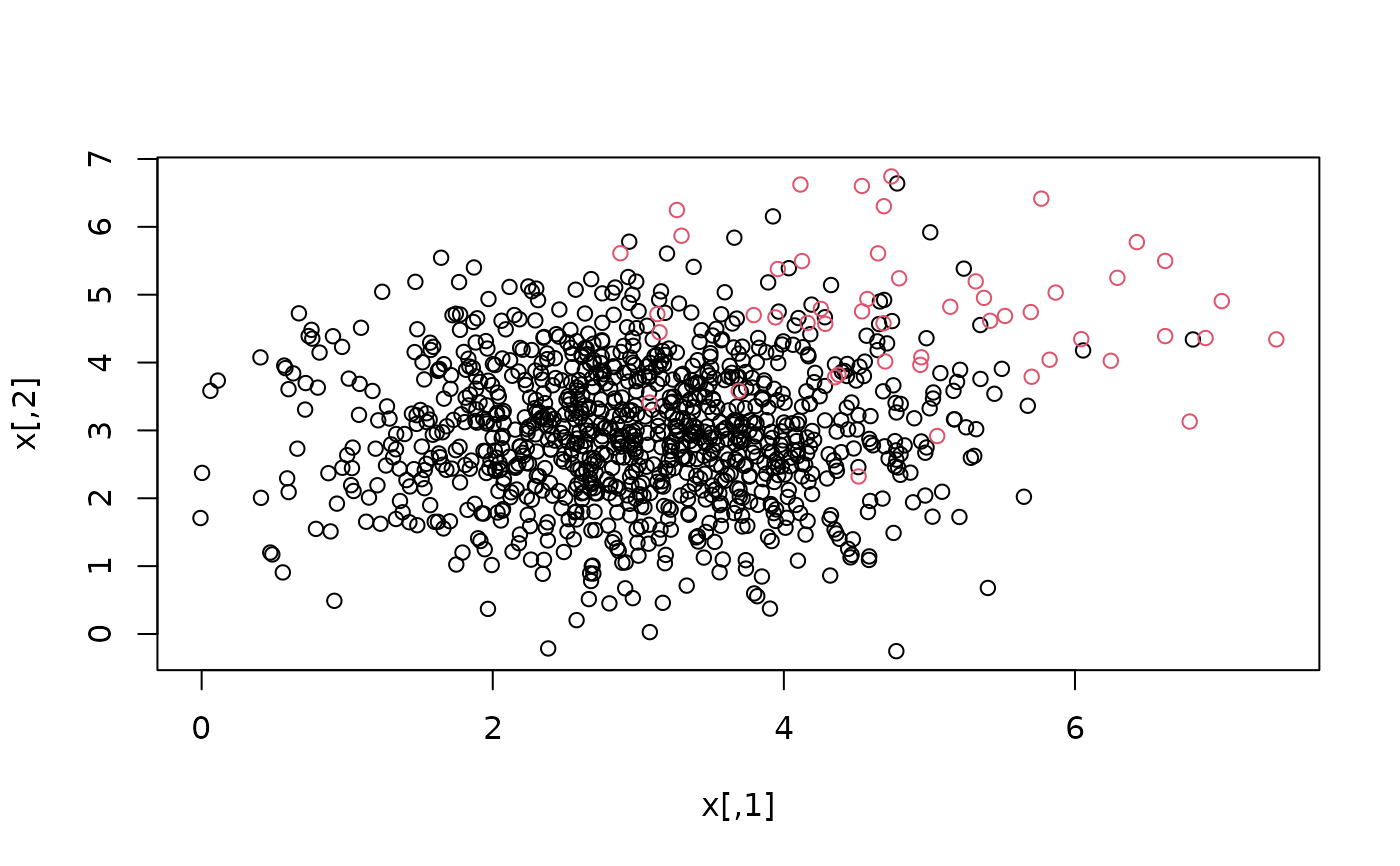
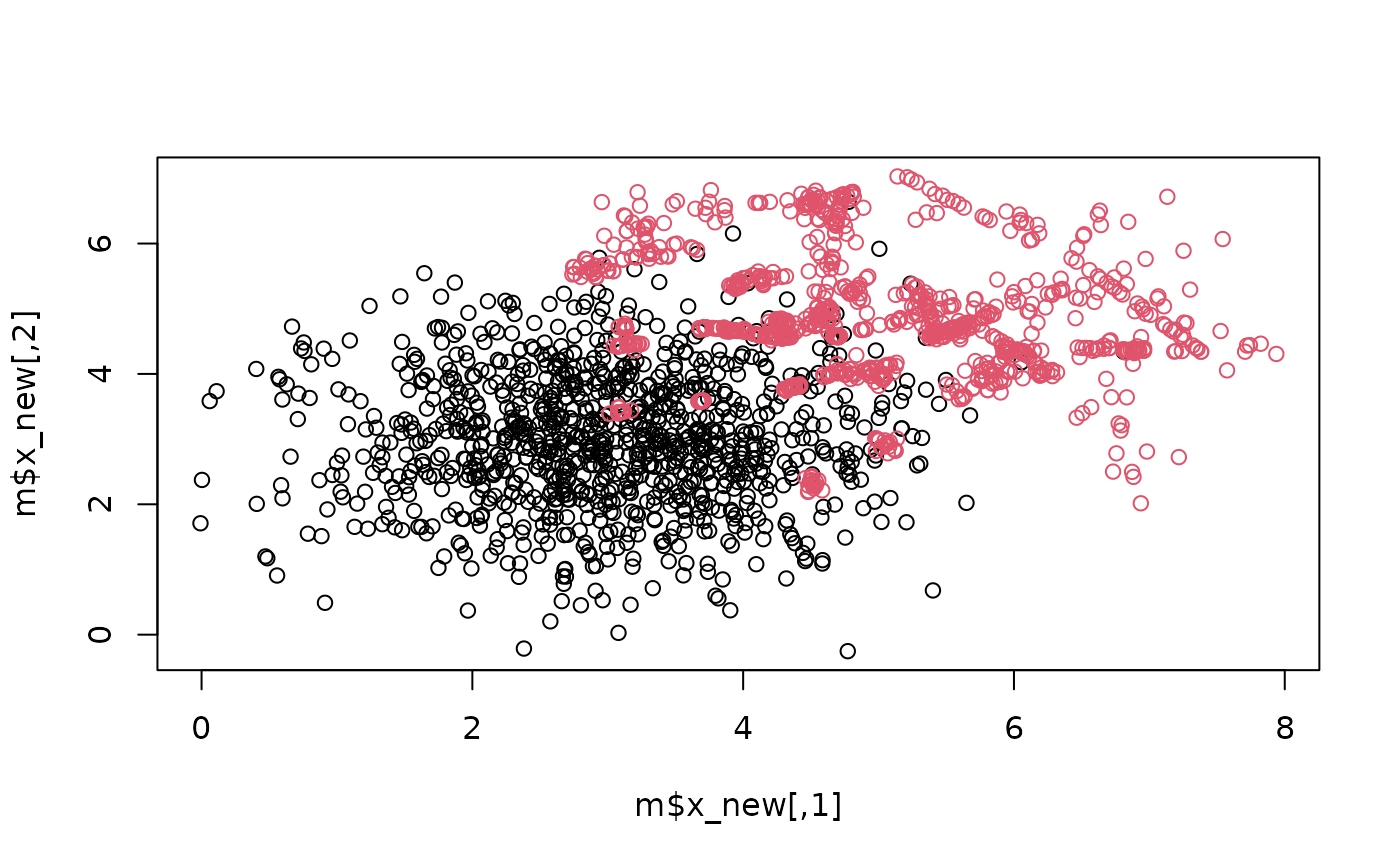
Bi-directional SMOTE (BiSMOTE, 2027)
BiSMOTE.RdResampling with bi-directional SMOTE.
Arguments
- x
feature matrix or dataframe.
- y
a factor class variable. Can have more than two classes.
- k
number of nearest neighbors within the class that define the interpolation directions. Default is 5. Reduced automatically for classes with fewer than
k + 1samples.- ovRate
Oversampling rate. Class \(j\) receives
round(ovRate * (n_max - n_j))synthetic samples, wheren_maxis the size of the largest class (halves are rounded up). Default is 1 meaning full balance. A vector with one value per class is also accepted.- ...
not used.
Value
a list with resampled dataset.
- x_new
Resampled feature matrix.
- y_new
Resampled target variable.
- x_syn
Generated synthetic feature data.
- y_syn
Generated synthetic label data.
Details
Year: 2027.
BiSMOTE (Saglam & Yamak, 2027) is a geometrically constrained oversampling
method. For each synthetic sample, a center sample and one of its k
nearest neighbors from the same class are selected. Unlike SMOTE, which places
the new sample between the two, BiSMOTE interpolates bi-directionally
along the line through them. The interpolation coefficient is drawn uniformly
so that the synthetic sample stays within the distance from the center
sample to its nearest sample of another class. In this way, generation is
restricted to a locally bounded region and does not cross towards
other classes, which reduces class overlap and synthetic noise.
Can work with classes more than 2.