Radius-SMOTE (RadiusSMOTE, 2021)
RadiusSMOTE.RdResampling with RadiusSMOTE.
Arguments
- x
feature matrix or data.frame.
- y
a factor class variable. Can have more than two classes.
- k
number of neighbors used to decide whether a sample is safe (a sample is safe when more than
k / 2of itsknearest neighbors in the whole data are from its own class). Default is 5.- ovRate
Oversampling rate. Class \(j\) receives
round(ovRate * (n_max - n_j))synthetic samples, wheren_maxis the size of the largest class (halves are rounded up). Default is 1 meaning full balance. A vector with one value per class is also accepted.- ...
not used.
Value
a list with resampled dataset.
- x_new
Resampled feature matrix.
- y_new
Resampled target variable.
- x_syn
Generated synthetic feature data.
- y_syn
Generated synthetic label data.
Details
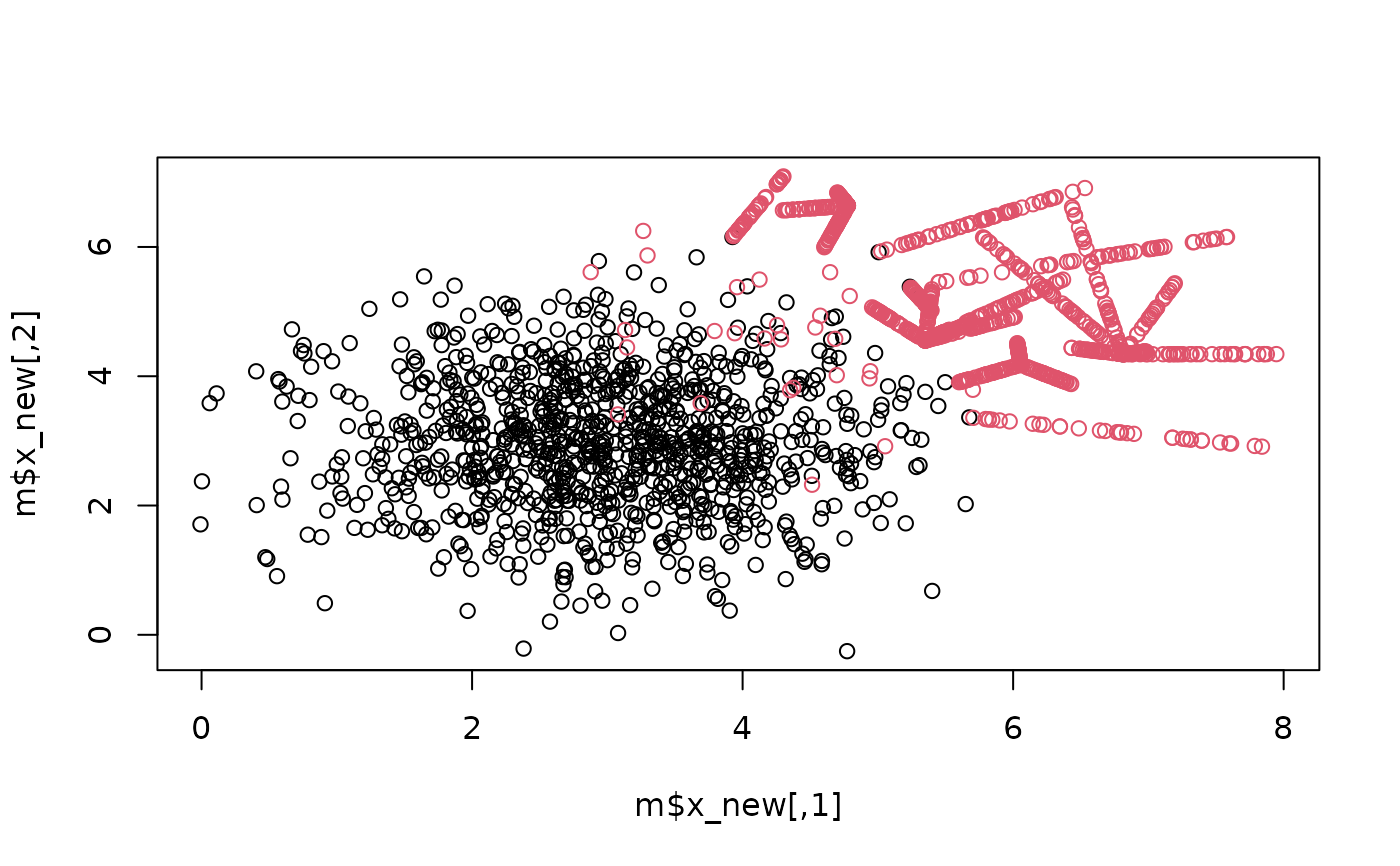
Year: 2021. Samples of the class that are safe are used as centers. Synthetic samples are generated on the line between a center and its nearest sample of the other classes, either towards it or in the opposite direction, at a random distance of at most the distance to that sample (the safe radius), so they do not reach the other classes. If no sample is safe, all samples are used with a warning.
Can work with classes more than 2: every class is oversampled against the union of the other classes (one-versus-rest).
References
Pradipta, G. A., Wardoyo, R., Musdholifah, A., & Sanjaya, I. N. H. (2021). Radius-SMOTE: a new oversampling technique of minority samples based on radius distance for learning from imbalanced data. IEEE Access, 9, 74763-74777.
Examples
set.seed(1)
x <- rbind(matrix(rnorm(2000, 3, 1), ncol = 2, nrow = 1000),
           matrix(rnorm(100, 5, 1), ncol = 2, nrow = 50))
y <- as.factor(c(rep("negative", 1000), rep("positive", 50)))

m <- RadiusSMOTE(x = x, y = y, k = 5)
table(m$y_new)
#>
#> negative positive
#>     1000     1000
plot(m$x_new, col = m$y_new)